Cape Town Tree Felling: Alien Invasive Plant Clearing & NEMBA Compliance in Cape Town, Western Cape
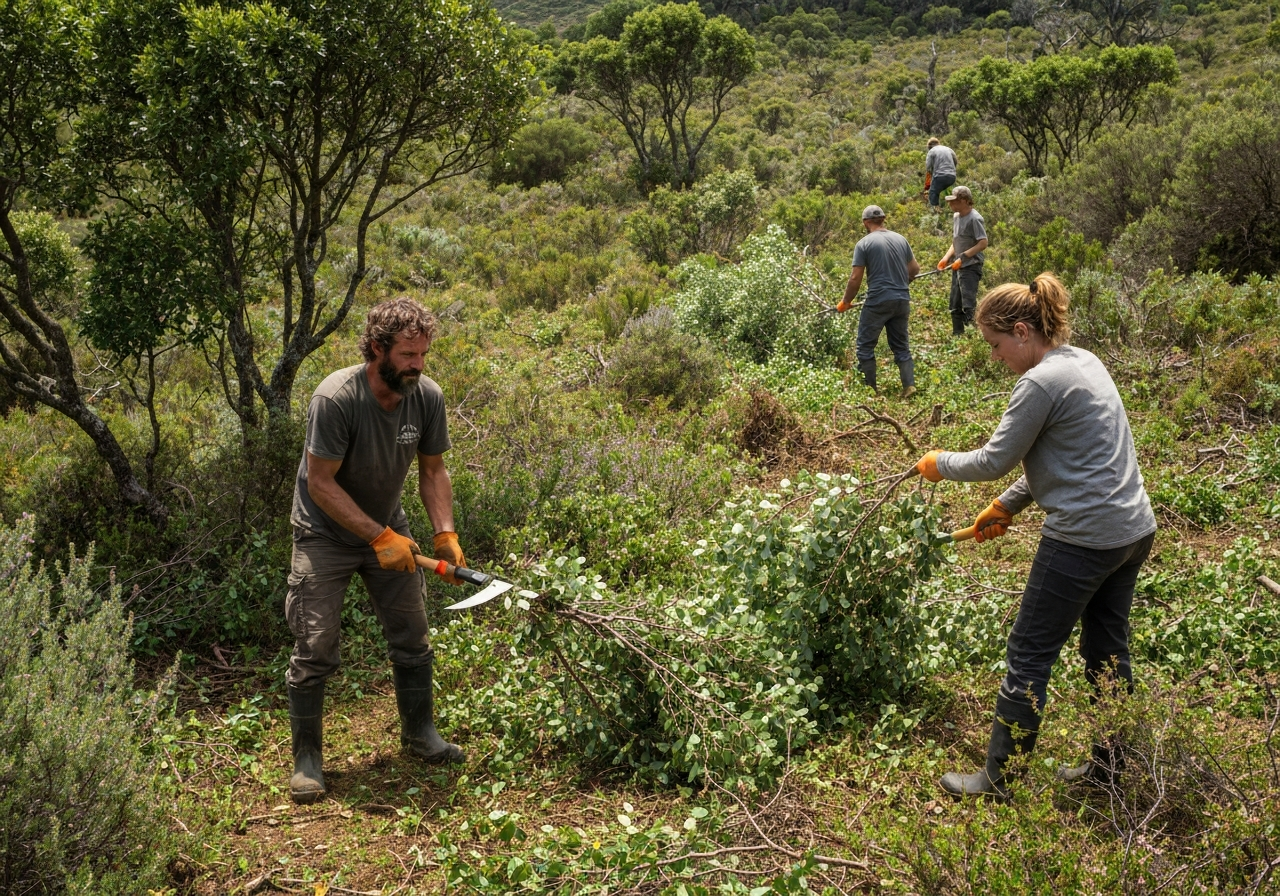
Cape Town Tree Felling provides NEMBA-compliant alien invasive plant clearing and control services across Cape Town’s Northern Suburbs, Western Cape. Our arborists are trained in species identification, NEMBA compliance, and the herbicide protocols required to prevent regrowth from the long-lived alien invasive seed banks that characterise the Cape Floristic Region.
- Husqvarna 550 XP Mark II climbing saw, Husqvarna 572XP felling saw, Petzl ZIGZAG rigging systems
- NEMBA-compliant species identification and alien invasive disposal
- Same-day free on-site quotations — no call-out fee
- 24/7 emergency line available for urgent situations
Get Your Free On-Site Quote
No call-out fee · Same-day assessments available
Mon–Sun 7am–6pm · 24/7 Emergency Line
Invasive Species We Clear — Cape Town
Port Jackson Willow Acacia saligna
Category 1b — must be removed. Dominant invasive on the Cape Flats and Bottelary/Tygerberg Hills. Produces 40,000+ seeds per year with 50-year viability. Cut-stump Triclopyr 480g/L treatment within 30 seconds of cut — essential to prevent vigorous root suckering. Annual follow-up required for seed bank management.
Rooikrans Acacia cyclops
Category 1b. Common in sandy coastal soils, Cape Flats, and West Coast. Bright red arils attract birds that spread seeds widely. Cleared by cut-stump method; seed raking and removal required from topsoil layer to depth of 50mm to prevent mass germination after clearing.
Black Wattle Acacia mearnsii
Category 1b in riparian zones. High water use — each large wattle removes 40–60 litres/day from groundwater. Common along the Kuils, Eerste, Diep, and Eerste rivers in the Northern Suburbs. Stump treatment with Garlon 4 is mandatory — black wattle vigorously root-sprouts without chemical treatment.
Blue Gum Eucalyptus spp.
Category 2 (permit required to retain on sensitive land). Common in industrial areas, farms, and older properties. Develops hidden trunk decay detectable only by probe sounding. Prolific root-sprouting after cutting. All stumps require immediate Garlon 4 application. Chips from blue gum should not be used as mulch near fynbos — allelopathic compounds inhibit native plant germination.
Spanish Reed Arundo donax
Category 1b. Dense monocultures along rivers and wetlands, displacing native riparian fynbos. Cannot be removed by cutting alone — rhizomes must be excavated to 400mm depth and treated with glyphosate 360g/L. Very labour-intensive; typically R8,000–R25,000 per 100m² depending on density.
Hakea Hakea spp.
Category 1b. Extremely sharp spines (30–80mm) require EN 381-5 anti-cut PPE for all personnel. Common in Swartland Shale Renosterveld, Bot River, and inland areas. Seed pods require high-temperature treatment (80°C+) after removal to prevent germination from collected seed.
Our Alien Invasive Clearing Process
- Site assessment & species mapping (Day 1): An arborist identifies all invasive species present, estimates density and coverage, reviews NEMBA category requirements, and confirms permit status. Written report provided with compliance recommendations.
- Mechanical clearing: Husqvarna 572XP for stems over 50mm, Husqvarna 340i battery brush-cutter for dense regrowth and seedlings. Stems stacked for chipping or removal — not left on-site to prevent re-rooting.
- Stump treatment (critical — within 30 seconds of cut): Garlon 4 (Triclopyr 480g/L) applied at 100% concentration to freshly cut stump face and cambium layer. Time-critical — treatment efficacy drops significantly after 30 seconds of air exposure to the cut surface. We treat each stump immediately after cutting — not at the end of the day.
- Material disposal: All material chipped on-site (Bandit Model 65) or removed to a licensed green waste facility. Alien invasive chips are NOT left as mulch near fynbos — allelopathic compounds inhibit native vegetation recovery. Seed-bearing material (hakea pods, rooikrans arils) is bagged and removed separately.
- Soil disturbance management: Cleared sites are often covered with weed fabric or seeded with indigenous ground covers within 2 weeks to prevent mass alien germination in disturbed soil. We advise on post-clearing restoration planting.
- Follow-up clearing (3–6 months): Alien seed banks in the Cape Floristic Region are extremely persistent — Port Jackson seeds remain viable for 50+ years. A 3–6 month follow-up visit to treat regrowth and any new seedlings germinated from the seed bank is included in all clearing contracts over R5,000.
Frequently Asked Questions — Alien Invasive Clearing Cape Town
Service Areas — Cape Town & Northern Suburbs
Related services: Tree Felling · Stump Grinding · Emergency Removal · Durbanville · Brackenfell
📞 021 813 0456 · ✉️ [email protected] · Mon–Sun 7am–6pm
Areas We Serve — Cape Town Northern Suburbs
We provide this service across Cape Town. Choose your area for local pricing, response times, and area-specific information:
Durbanville
Northern Suburbs · 15–25 min emergency response · Clay estate soils
Durbanville tree services →
Brackenfell
Northern Suburbs · 20–30 min emergency response · Blue gum legacy
Brackenfell tree services →
Also covering all Cape Town Northern Suburbs.
Call 021 813 0456 to confirm availability in your area.
Areas We Cover
We provide this service across all Cape Town suburbs. Top areas:
→ View all areas: tree felling Cape Town