Cape Town Tree Felling: Tree Pruning, Crown Reduction & Deadwooding in Cape Town, Western Cape
Tree trimming and tree pruning describe the same work, and tree cutting is the term most people reach for when they mean it. What changes the price is which cut the tree needs: a crown reduction takes the whole canopy back proportionally, a crown thinning opens it up without changing its outline, and deadwooding removes only the dead limbs and leaves the live structure alone. A tree that has outgrown its position needs the first, a tree blocking light needs the second, and a tree that is simply old needs the third.
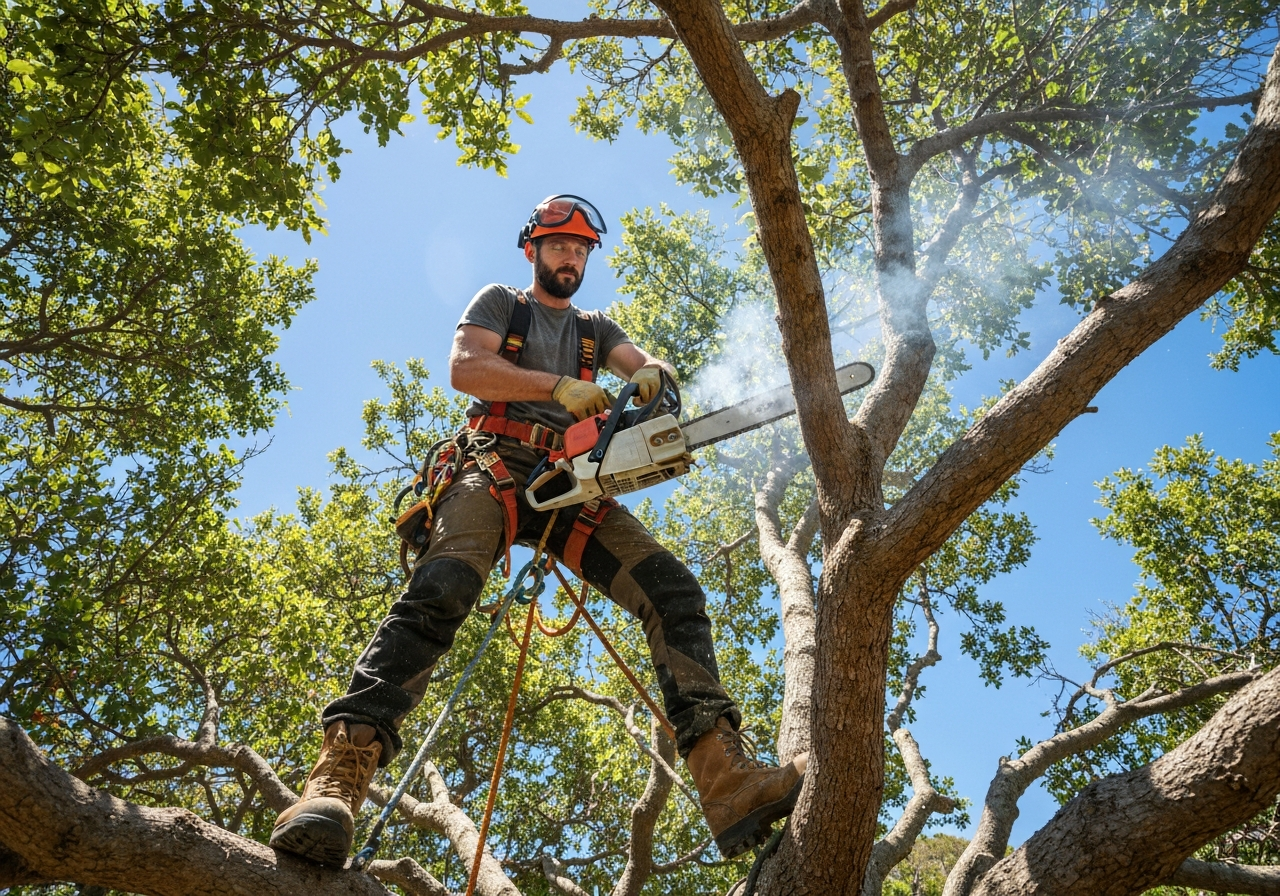
Cape Town Tree Felling provides professional tree pruning, crown reduction, and deadwooding services in Cape Town, Western Cape. Our arborists prune strictly to ISA / ANSI A300 pruning standards, ensuring every cut promotes tree health rather than causing long-term structural damage.
Why Choose Cape Town Tree Felling:
- Husqvarna 550 XP Mark II climbing saw, Husqvarna 572XP felling saw, Petzl ZIGZAG rigging systems
- NEMBA-compliant species identification and alien invasive disposal
- Same-day free on-site quotations — no call-out fee
- 24/7 emergency line available for urgent situations
⚠️ Warning — “Topping” causes permanent damage: Topping (cutting back main leaders to stubs) is internationally condemned by the ISA as the single most harmful pruning practice. It causes rapid water-sprout regrowth, internal decay, and significantly increases storm-failure risk within 3–5 years. Any contractor recommending topping should not be trusted with your trees. We never top — we reduce using proper reduction cuts to lateral branches at least 1/3 the diameter of the removed stem.
Get Your Free On-Site Quote
No call-out fee · Same-day assessments available
📱 Call 021 813 0456
Mon–Sun 7am–6pm · 24/7 Emergency Line
Tree Pruning Services — Cape Town
☠️ Deadwooding
Systematic removal of dead, dying, and diseased branches per ANSI A300 standards. Dead branches over 50mm diameter over buildings or high-traffic areas are a primary storm-damage liability. Cape Town’s winter NW fronts (60–100km/h gusts) are responsible for the majority of property damage claims from tree failures. From R950.
🌿 Crown Reduction
Reduces overall canopy volume by 20–30% using lateral reduction cuts — maintaining natural crown form while reducing wind load, weight, and light blockage. Cuts made to laterals at minimum 1/3 stem diameter per ANSI A300 standard. Standard for large oaks, plane trees, and liquidambars in Durbanville estates. From R1,800.
🏡 Crown Lifting
Removes lower branches to raise canopy clearance — standard is 2.5m above ground for pedestrians, 4.5m for vehicles. Improves light penetration to gardens and lawns, clears rooflines, and eliminates ladder access to boundary walls. Done using Husqvarna 550 XP Mark II climbing saw. From R850.
🌱 Formative Pruning
Early-stage structural correction for young trees — removing co-dominant stems (V-shaped unions with included bark), crossing branches, and epicormic growth. Best investment in tree management: a R450 pruning on a 2-year sapling prevents a R6,000 removal job in 15 years. From R450.
Pruning Pricing Guide — Cape Town
| Service |
Tree Size |
Time |
Price |
| Deadwooding |
Medium (5–10m) |
2–4 hrs |
R950–R2,200 |
| Crown Reduction |
Medium (5–10m) |
3–6 hrs |
R1,800–R4,500 |
| Crown Reduction |
Large (10–18m) |
1–2 days |
R4,500–R8,000 |
| Crown Lifting |
Any size |
1–3 hrs |
R850–R2,000 |
| Formative Pruning |
Young tree (under 4m) |
30–90 min |
R450–R950 |
Frequently Asked Questions — Tree Pruning Cape Town
When is the best time to prune trees in Cape Town?
Cape Town’s Mediterranean climate (Köppen Csb) creates distinct pruning windows by species: Deciduous trees (oak, plane, liquidambar, jacaranda) are best pruned in winter dormancy June–August when leafless. Fruit trees are pruned immediately after harvest (typically June for most Cape fruit). Evergreen trees (pine, olive, camphor) can be pruned year-round, ideally March–May before winter storms. Deadwooding and crown reduction for storm preparation should be scheduled by April/May — 6–8 weeks before winter wind season begins.
How much does tree pruning cost in Cape Town?
Tree pruning in Cape Town ranges from R450 for formative pruning on young trees to R8,000+ for full crown reduction on a large 15m oak or plane tree. The main cost drivers are: (1) tree height — work above 5m requires climbing equipment, (2) volume of wood to be removed and chipped, and (3) proximity to structures. Annual deadwooding programmes for sectional title complexes are quoted per tree and include 10–20% multi-tree discounts. All quotes are free on-site with no obligation.
What is crown reduction and is it harmful to the tree?
Crown reduction is the reduction of a tree’s overall size by making pruning cuts to lateral branches — maintaining the tree’s natural shape while reducing its volume. Correctly performed crown reduction (using ISA / ANSI A300 standards, cutting to laterals at least 1/3 the removed stem diameter) is not harmful and promotes structural integrity. Incorrectly performed topping (cutting back main leaders to stubs) IS harmful — causing decay, epicormic regrowth, and significantly increased storm-failure risk within 3–5 years. Always ask for the arborist’s qualifications and insurance before authorising crown reduction work.
How often should I prune my trees in Cape Town?
Annual deadwooding for trees over 8m near structures, buildings, or high-traffic areas — this is the most important recurring maintenance. Crown reduction every 3–5 years for large canopy trees. Crown lifting as needed when clearance is reduced by new growth (typically every 3–4 years for fast-growing species). Formative pruning on young trees every 2–3 years until structural scaffold is established (first 8–10 years). For properties with many mature trees, consider an annual maintenance contract — we offer 10–15% discounts for multi-visit programmes.
Do pruning cuts need to be sealed with wound paint?
No — research has consistently shown that wound sealants (bituminous paints, pruning pastes) do not improve wound closure and may actually trap moisture and promote decay. The current ISA consensus is that clean, correct pruning cuts (outside the branch collar, not flush to the stem) heal best when left exposed. The tree’s own compartmentalisation process (CODIT — Compartmentalization of Decay in Trees) is more effective than any sealant. Exceptions: freshly cut surfaces of alien invasive species (Port Jackson, blue gum) should receive immediate Triclopyr herbicide application to prevent resprouting.
Can tree pruning prevent my tree from falling in a storm?
Yes — significantly. Deadwooding removes the primary source of storm-induced branch failure. Crown reduction reduces wind-sail effect by 20–40%, substantially lowering the overturning moment on the root system during high winds. Cape Town’s south-easter (December–February) and winter NW storms (June–September) generate gusts that regularly exceed 80km/h in the Northern Suburbs. Trees with over-extended canopies, significant deadwood, or co-dominant stems are at highest risk. A R2,500 crown reduction job can prevent a R15,000 emergency removal callout.
What equipment do your arborists use for climbing and pruning?
Our climbing arborists use Petzl ZIGZAG mechanical Prusik systems for tree access, Yale double-braid polyester climbing lines, and Petzl Adjama harnesses rated to EN 358/EN 361 standards. All cutting is performed with Husqvarna 550 XP Mark II top-handle chainsaws (50cc, 2.6kW) for elevated work and Husqvarna 572XP for ground-level larger cuts. PFERD round files are used for on-site chain sharpening to ensure clean cuts that minimise wood tearing and disease entry at cut surfaces.
Does tree pruning affect my property value?
Mature, well-maintained trees increase Cape Town residential property values by 5–15% according to industry appraisals. Correctly pruned trees with healthy, structured canopies are a significant asset. Overgrown, untidy, or topped trees can actually reduce valuations if they are assessed as potential liabilities. From a risk management perspective, regular pruning documentation (dates, works performed, arborist’s qualifications) also strengthens your position if a neighbour or third party makes a claim for tree damage.
Service Areas — Cape Town & Northern Suburbs
✓ Durbanville
✓ Brackenfell
✓ Bellville
✓ Kraaifontein
✓ Goodwood
✓ Parow
✓ Kuilsrivier
✓ Tableview
✓ Bloubergstrand
✓ Edgemead
✓ Plattekloof
✓ Monte Vista
✓ Kenridge
✓ Welgevonden
✓ Tygervalley
✓ Bothasig
✓ Thornton
✓ Pinelands
✓ Maitland
✓ Milnerton
✓ Parklands
✓ Constantia
✓ Rondebosch
✓ Claremont
Related services: Tree Felling · Stump Grinding · Emergency Removal · Durbanville · Brackenfell
Areas We Serve — Cape Town Northern Suburbs
We provide this service across Cape Town. Choose your area for local pricing, response times, and area-specific information:
Northern Suburbs · 15–25 min emergency response · Clay estate soils
Durbanville tree services →
Northern Suburbs · 20–30 min emergency response · Blue gum legacy
Brackenfell tree services →
Also covering all Cape Town Northern Suburbs.
Call 021 813 0456 to confirm availability in your area.
Areas We Cover
We provide this service across all Cape Town suburbs. Top areas:
→ View all areas: tree felling Cape Town
Related Tree Services