Cape Town Tree Felling: Palm Tree Removal, Cleaning & Skirt Removal in Cape Town, Western Cape
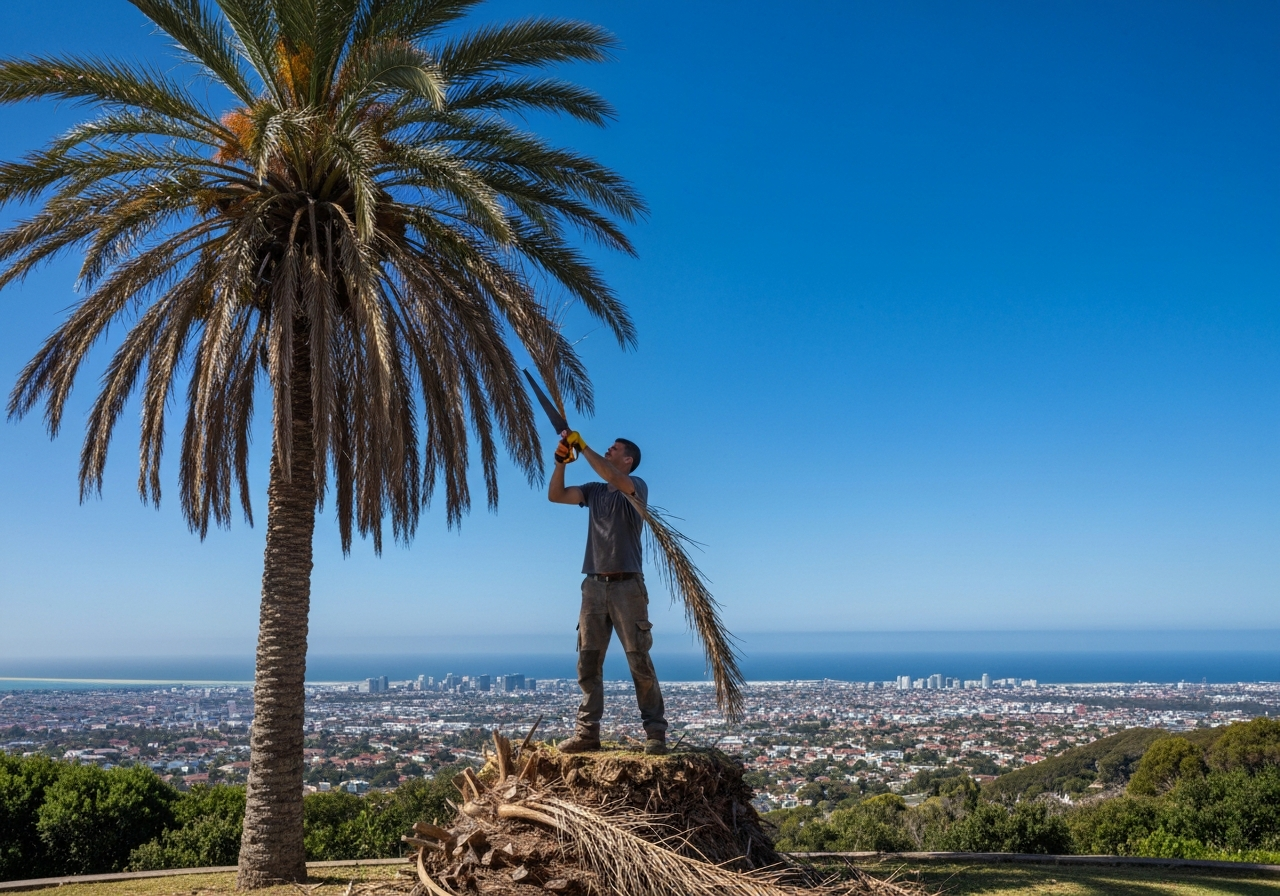
Cape Town Tree Felling provides professional palm tree maintenance, skirt removal, and complete palm felling across Cape Town’s Northern Suburbs, Western Cape. Our arborists understand the specific risks and techniques required for each palm species found in the Cape Town area.
Why Choose Cape Town Tree Felling:
- Husqvarna 550 XP Mark II climbing saw, Husqvarna 572XP felling saw, Petzl ZIGZAG rigging systems
- NEMBA-compliant species identification and alien invasive disposal
- Same-day free on-site quotations — no call-out fee
- 24/7 emergency line available for urgent situations
🔥 Cape Town Fire Season Warning: Dead palm frond skirts are classified as a Category A fire hazard by the City of Cape Town’s Fire and Rescue Service. During Cape Town’s fire season (November–March), dry palm skirts can ignite from a single cigarette butt, nearby veld fire ember, or spontaneous combustion on days above 35°C. The City’s Fire Service recommends skirt removal before 1 November each year for palms within 5m of structures.
Get Your Free On-Site Quote
No call-out fee · Same-day assessments available
📱 Call 021 813 0456
Mon–Sun 7am–6pm · 24/7 Emergency Line
Palm Services We Provide
🌿 Frond Removal (Cleaning)
Removal of dead and senescent fronds — cut at the natural abscission zone (base of the petiole), retaining the green frond bases (boots) for structural support. Frond removal should not strip the green crown — removal of living green fronds reduces the palm’s photosynthetic capacity and should be limited to fronds below the horizontal (9 o’clock / 3 o’clock position). From R450 per palm.
🔥 Skirt Removal
Complete removal of accumulated dead frond “skirt” — including petiole bases and retained frond stubs on the trunk — using reciprocating saws and hand-chisels where needed. Exposes the trunk surface for inspection of pest and disease activity. Critical annual maintenance before Cape Town’s fire season (November). From R650 per palm.
🪚 Complete Palm Felling
Phoenix canariensis (Canary Island date palm) spines require PPE-rated anti-cut chainsaw chaps and gloves (EN 381-5 rated) — these palms cannot be climbed with standard arborist equipment due to 60–150mm recurved spines. We use extendable pole saws for crown work and directional felling or crane-assisted sectional cuts for complete removal. From R1,200.
🌿 Seed Head & Flower Removal
Removal of date/seed flower clusters from Phoenix and Washingtonia species — prevents slippery fruit drop on paved areas, reduces pest attraction (rats, hadeda ibis), and avoids seedling germination in paving joints. Typically done annually in late summer (February–March). From R350.
Palm Species Pricing Guide — Cape Town
| Species |
Service |
Access |
Price |
| Washingtonia (thread palm) |
Frond + skirt removal |
Climbable |
R650–R950 |
| Phoenix canariensis |
Frond + skirt removal |
Pole/PPE required |
R1,200–R1,800 |
| Washingtonia (under 8m) |
Complete felling |
Direct fell |
R1,200–R2,000 |
| Phoenix canariensis |
Complete felling |
Sectional/crane |
R3,500–R8,000 |
Frequently Asked Questions — Palm Tree Services Cape Town
How often should I have my palms cleaned in Cape Town?
Annual cleaning is the standard for most palms in Cape Town — ideally before November (fire season start). Fast-growing Washingtonia palms produce 12–15 fronds per year and require annual maintenance to prevent skirt accumulation. Slower-growing Phoenix canariensis (Canary Island date palm) requires frond removal every 12–18 months. Palms in high-visibility residential settings or near structures with fire risk should be cleaned annually without exception.
Are palm skirts really a fire risk in Cape Town?
Yes — significantly. Palm frond skirts are composed of highly flammable dry cellulose material with excellent airflow through the hanging frond structure. They ignite readily from any ignition source (cigarettes, embers from nearby veld fires, or spontaneous combustion at temperatures above 35°C) and burn intensely — hot enough to crack and damage masonry walls and ignite adjacent roofing. The City of Cape Town’s Fire and Rescue Service has investigated numerous structure fires started by ignited palm skirts in the Northern Suburbs. Annual skirt removal before the summer fire season (November–March) is essential for palms within 5m of any structure.
Can Phoenix canariensis (Canary Island date palm) spines cause serious injury?
Yes — Phoenix canariensis spines (60–150mm, extremely hard, recurved at base) cause deep puncture wounds that have high infection risk. They are classified as a workplace safety hazard under South African OHS regulations. Unprotected contact with the lower frond spines while climbing is the primary cause of arborist injury on this species. Our team uses EN 381-5 rated anti-cut chainsaw chaps, full-length anti-cut gloves, and face protection when working on Phoenix canariensis. Never attempt DIY maintenance on Canary Island date palms without proper PPE.
Why is my Washingtonia palm turning brown at the top?
Browning at the crown spear (the newest central frond) in Washingtonia palms is usually caused by one of three issues: (1) Fusarium wilt (Fusarium oxysporum f.sp. palmarum) — a fatal vascular disease with no cure, progressing from the spear down, (2) Diamond-scale fungus (Phaeochoropsis neowashingtoniae) — causes brown diamond-shaped lesions on fronds, treatable with fungicide, or (3) Frost or nutrient deficiency — browning of oldest fronds first rather than the spear. Our arborists assess and diagnose palm health issues as part of the free quotation visit.
Can palm trees be transplanted rather than removed?
Palms with trunk heights under 4m can sometimes be successfully transplanted, particularly Washingtonia and Phoenix reclinata (wild date palm). Transplanting involves digging a root ball 600–900mm in diameter, pre-conditioning the palm with reduced watering 3–4 weeks before moving, and replanting within 24 hours into a prepared hole with 1:1 compost-soil mix. Survival rate for correctly transplanted Washingtonia under 4m is approximately 75–85%. Phoenix canariensis transplanting has a lower success rate (60–70%) due to large root ball requirement. We assess transplanting viability during the free quotation visit.
Service Areas — Cape Town & Northern Suburbs
✓ Durbanville
✓ Brackenfell
✓ Bellville
✓ Kraaifontein
✓ Goodwood
✓ Parow
✓ Kuilsrivier
✓ Tableview
✓ Bloubergstrand
✓ Edgemead
✓ Plattekloof
✓ Monte Vista
✓ Kenridge
✓ Welgevonden
✓ Tygervalley
✓ Bothasig
✓ Thornton
✓ Pinelands
✓ Maitland
✓ Milnerton
✓ Parklands
✓ Constantia
✓ Rondebosch
✓ Claremont
Related services: Tree Felling · Stump Grinding · Emergency Removal · Durbanville · Brackenfell
Areas We Serve — Cape Town Northern Suburbs
We provide this service across Cape Town. Choose your area for local pricing, response times, and area-specific information:
Northern Suburbs · 15–25 min emergency response · Clay estate soils
Durbanville tree services →
Northern Suburbs · 20–30 min emergency response · Blue gum legacy
Brackenfell tree services →
Also covering all Cape Town Northern Suburbs.
Call 021 813 0456 to confirm availability in your area.
Areas We Cover
We provide this service across all Cape Town suburbs. Top areas:
→ View all areas: tree felling Cape Town
Related Tree Services