Rooikrans (Acacia cyclops): Coastal Invader, Category 1b, and the Best Braai Wood in the Cape
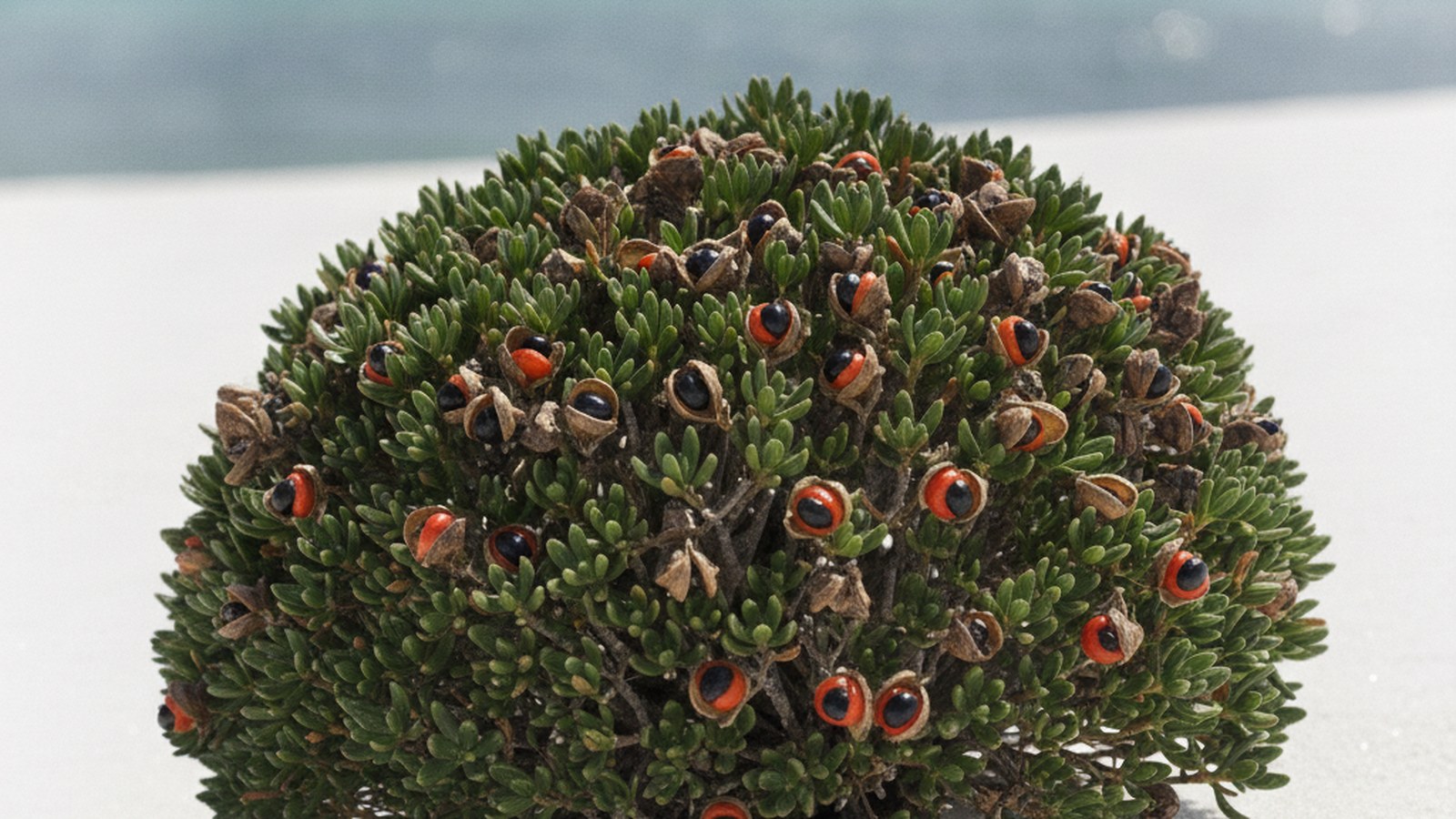
Rooikrans — Acacia cyclops — is a NEMBA Category 1b invader that a landowner is required to control. It was planted on Cape dunes from the 1800s to stabilise drifting sand, and it now runs along the coast from the West Coast round to the Overberg. It is also the densest, longest-burning braai wood in the Western Cape, which is the one invasive tree whose removal partly pays for itself.
How to tell it apart
| Feature | Rooikrans (Acacia cyclops) |
|---|---|
| Leaves | Short, blunt, dark green phyllodes — stiffer and much shorter than Port Jackson’s |
| Flowers | Yellow globular heads, scattered through much of the year |
| Seeds | The giveaway: a black seed encircled by a thick bright red-orange aril, giving the pod a red-rimmed look |
| Form | Dense, rounded, multi-stemmed shrub to small tree, commonly 2–5 m |
| Where | Coastal dunes, sandy coastal flats, lower fynbos slopes |
| NEMBA | Category 1b — control required |
The wood
Why is rooikrans considered such good braai wood?
Rooikrans is dense and low in resin, so it burns down to a long-lived, even coal bed rather than flaring and dying. That is exactly what a braai wants. It is the one Cape invasive with a genuine firewood market, and cleared stands are routinely cut, split and sold rather than chipped.
Does clearing it damage the dunes?
Rooikrans was planted to hold sand, so clearing a large coastal stand in one pass on a mobile dune can expose bare sand. On dune systems the work is staged and paired with indigenous re-establishment. On ordinary residential and smallholding ground away from active dunes this is not a constraint.
Will it come back?
Yes, unless the stumps are treated and the seedlings are followed up. Rooikrans seed is bird-dispersed — the red aril exists to attract birds — so re-infestation arrives from neighbouring stands as well as from the soil seed bank.
Rooikrans against the other Cape acacias
| Rooikrans | Port Jackson | Black wattle | |
|---|---|---|---|
| Leaf | Short, blunt, dark green phyllodes | Long, drooping blue-green phyllodes | Fine feathery bipinnate true leaves |
| Seed | Black seed in a thick red-orange aril | Pale folded aril | No conspicuous aril |
| Height | 2–5 m | 3–8 m | 10–15 m |
| Habitat | Coastal dunes | Sandy flats and disturbed ground | River banks and wet lowlands |
| Firewood | Excellent — dense, long coals | Poor — fast and light | Moderate |
| NEMBA | 1b | 1b | 1b riparian / 2 under permit |
What the firewood is worth
Rooikrans is sold by the bag and by the cubic metre across the Cape, and it consistently carries a premium over pine and Port Jackson because of how it burns. On a clearing job of any size that changes the economics: the straight stem wood is cut to braai lengths and stacked, and only the brush is chipped. Ask for the timber to be left on site if you want it — the default on most jobs is to chip everything, and once it is through the chipper the option is gone.