Port Jackson (Acacia saligna): Identification, Legal Status and How It Is Cleared
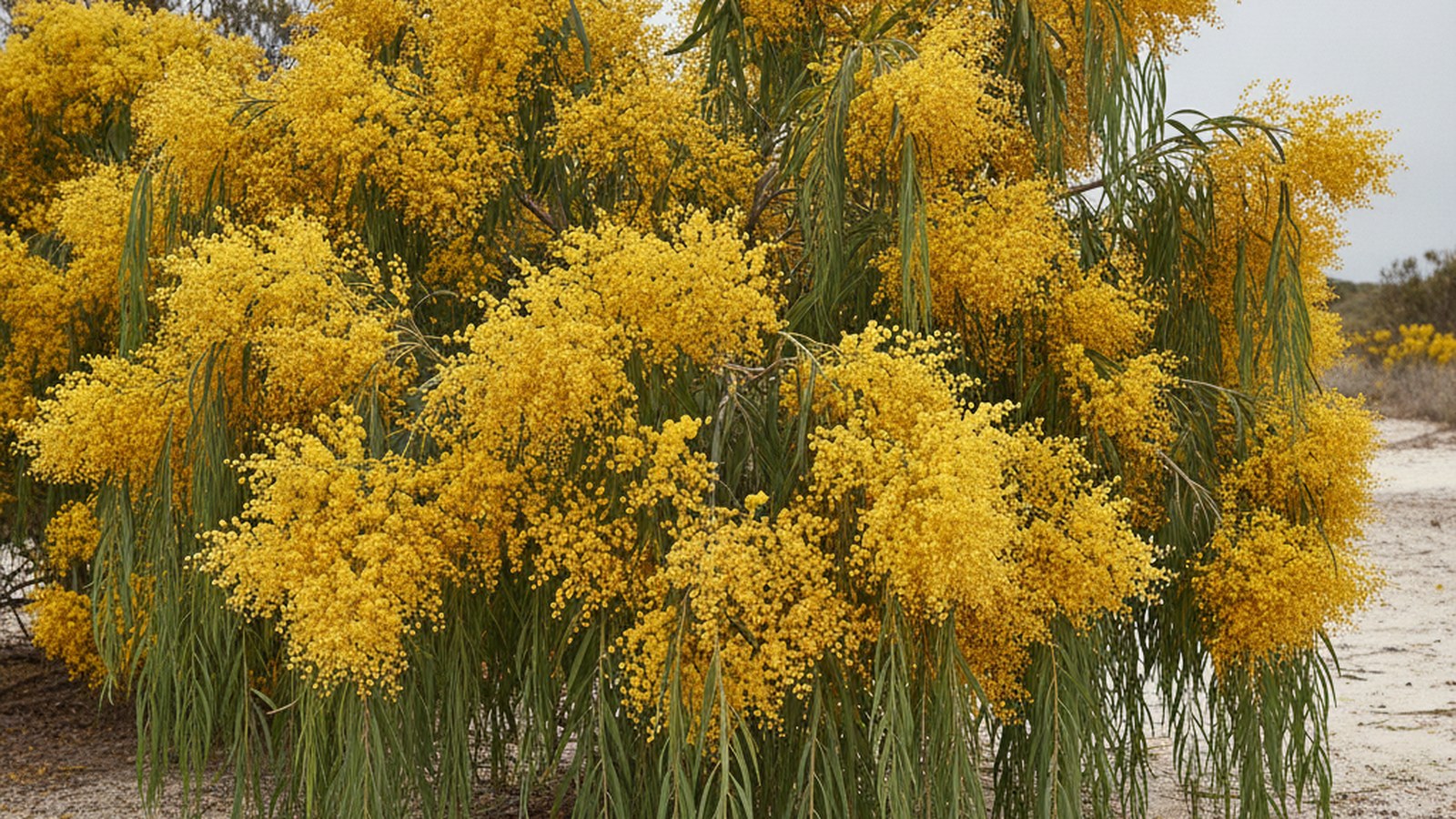
Port Jackson — Acacia saligna — is a NEMBA Category 1b invader, which means the landowner carries a legal duty to control it. It is an Australian wattle, brought to the Cape in the 1800s to bind drifting sand, and it now dominates huge stretches of the Cape Flats and disturbed sandy ground. It is recognised by long, narrow, drooping blue-green phyllodes and dense balls of bright yellow flowers in late winter and spring.
How to tell it apart
| Feature | Port Jackson (Acacia saligna) |
|---|---|
| Leaves | Long, narrow, drooping blue-green phyllodes — flattened leaf stalks, not true leaves |
| Flowers | Bright yellow globular heads, late winter into spring |
| Pods | Narrow, constricted between the seeds; seeds carry a folded pale aril |
| Form | Short-trunked, spreading, often multi-stemmed; commonly 3–8 m |
| Where | Sandy flats, road reserves, disturbed ground, old dune fields |
| NEMBA | Category 1b — control required |
Why it is so hard to get rid of
Why does it grow back after it is cut?
Port Jackson coppices vigorously from the stump, and it holds an enormous, long-lived seed bank in the soil. Felling alone converts one mature tree into a thicket of regrowth. Cut stumps have to be treated immediately, and the seedlings that follow have to be worked for several seasons.
What is the rust fungus on the branches?
Warty galls on the stems are Uromycladium gall rust, released in South Africa as a biological control agent against Port Jackson. It weakens and slowly kills infected trees. Biological control reduces seed production over time; it does not clear a stand on the timescale of a building project or a fire season.
Is the wood worth keeping?
Port Jackson burns fast and light. It is usable as kindling and rough firewood, but it is not in the class of rooikrans, which is why cleared Port Jackson is more often chipped on site than stacked.
How a Port Jackson stand is cleared
| Stage | What happens | Timing |
|---|---|---|
| 1. Survey | Stand density and stem sizes are recorded, and the boundary of the infestation is walked. Isolated outliers beyond the main stand are marked, because those are what re-seed cleared ground. | Day 1 |
| 2. Initial fell | Standing trees are cut low. On dense stands the material is chipped where it falls rather than dragged, which keeps the soil disturbance down. | Day 1–3 |
| 3. Stump treatment | Cut surfaces are treated immediately, while the stump is still fresh. A stump left untreated coppices from the collar and returns as a multi-stemmed bush. | Same day as the cut |
| 4. First follow-up | The seed bank germinates once light reaches the soil. Seedlings are pulled or treated while they are still soft-stemmed. | 6–12 months |
| 5. Repeat passes | Further passes until the seedling flush stops. This is the stage most owners skip, and skipping it undoes the initial clear. | Several seasons |