Pollarding: What It Is, How It Differs From Topping, and When It Is the Right Call
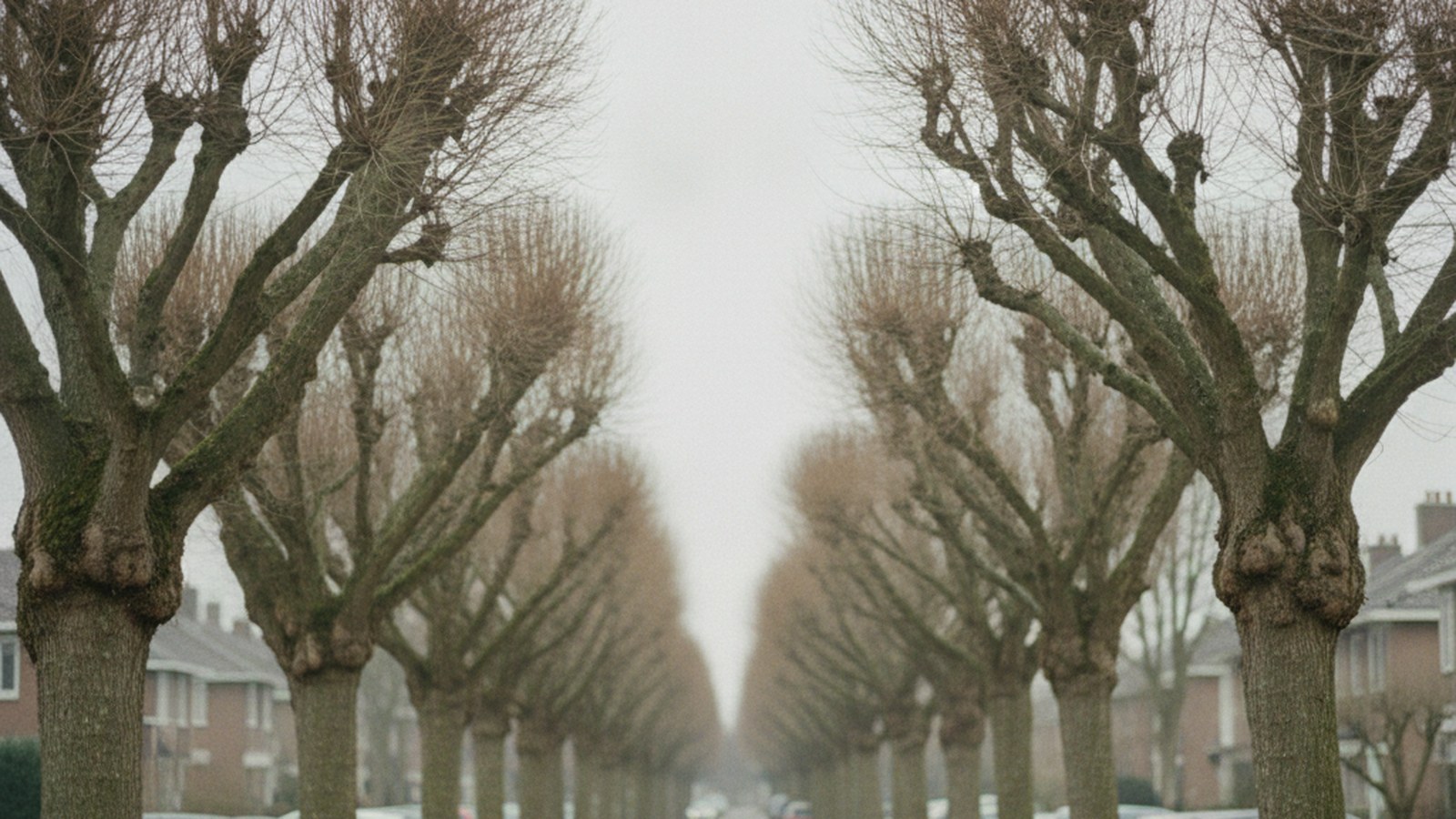
Pollarding is a pruning system that cuts a tree back to the same set of points every one to five years, so it forms permanent swollen knuckles — pollard heads — and never exceeds a chosen height. It is started on a young tree and then committed to for the life of that tree. It is not the same as topping, which is an indiscriminate cut through mature wood and leaves the tree weaker than it was.
Pollarding against topping
| Pollarding | Topping | |
|---|---|---|
| When it starts | On a young tree, before the stem is thick | On a mature tree, at any age |
| Where the cut falls | At the same points every cycle, into the pollard head | Anywhere convenient, through old wood |
| Wound response | Small wounds at a knuckle that the tree seals reliably | Large wounds in mature wood that often fail to seal and admit decay |
| Regrowth | Dense, attached shoots from the pollard head | Weakly attached water sprouts prone to tearing out |
| Repeat | A permanent commitment, on cycle | Usually repeated because the problem returns worse |
| Verdict | A legitimate management system | Damage, and widely rejected by arborists |
When it makes sense
What is pollarding actually for?
Pollarding keeps a tree that would naturally outgrow its position at a fixed, chosen size — under a power line, inside a small courtyard, along a narrow street, or where a large canopy would take all the light from a garden. It buys you a permanent small tree in a place that cannot hold a big one.
How often does it have to be repeated?
Every one to five years, depending on species and how vigorously it shoots. Once a tree is pollarded the cycle cannot be abandoned: the shoots on an unmaintained pollard head keep thickening, and eventually the head carries heavy limbs on a weak union. Skipping cycles is how a pollarded tree becomes a hazard.
Can an old tree be pollarded for the first time?
No. Cutting a mature, never-pollarded tree back to a framework is topping, whatever it is called on the quote. On an established tree the right tools are crown reduction and crown thinning, which take the canopy back proportionally and keep the tree’s natural form.
Which trees take it well?
Species that shoot readily from cut wood — plane, willow, mulberry, oak, many eucalypts. Conifers as a group do not: most cannot produce new growth from old wood, and a pollarded conifer simply dies back.