Polyphagous Shot Hole Borer: How to Spot It, Which Trees It Kills, and Why the Wood Must Not Move
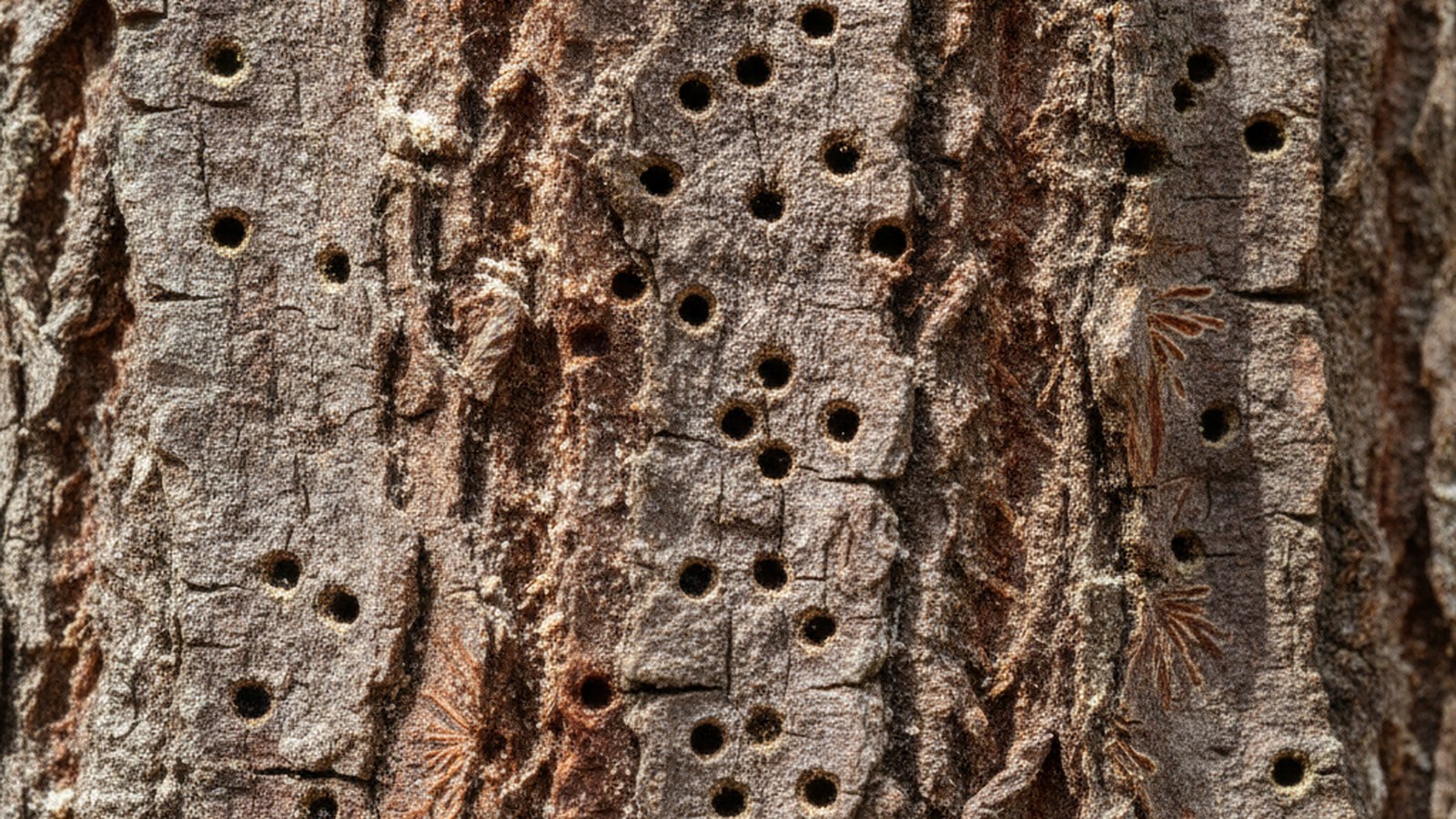
The polyphagous shot hole borer — Euwallacea fornicatus — is a beetle roughly 2 mm long that bores into a trunk and farms a Fusarium fungus inside the wood. The beetle eats the fungus; the fungus blocks the tree’s water-conducting tissue. It is the fungus that kills the tree. The giveaway is a scatter of perfectly round entry holes about the width of a pen tip, often with fine sawdust or a dark ooze around them.
What to look for
| Sign | What it looks like |
|---|---|
| Entry holes | Round, roughly 1 mm across, scattered over trunk and main limbs — like fine shot |
| Sawdust | Pale frass at the holes or collected in bark fissures |
| Staining | Dark wet patches, gumming or sugary exudate around the holes |
| Under the bark | Brown or black staining in the wood around each gallery |
| Canopy | Branch dieback that spreads limb by limb, then whole-tree collapse |
Which trees are at risk
The borer is polyphagous — the name means it accepts many hosts — but it only reproduces successfully in a subset of them. The reproductive hosts are what drive an outbreak. In South African urban settings the species repeatedly hit hardest are London plane, English oak and box elder, with a long tail of other broadleaf hosts. Plane and oak line a great many Cape Town streets and older gardens, which is why the pest matters here.
What to do about it
Can an infested tree be saved?
A lightly infested tree is sometimes held with treatment and close monitoring. Once the galleries are extensive and the canopy is collapsing, the tree is not recoverable and the question becomes how to remove it without spreading the beetle.
Why must the wood not be moved?
This is the single most important rule. The beetle lives inside the wood, and firewood is how it travels long distances in a single step. Infested material must not be carted to another property, sold as firewood, or dumped in a green-waste stream that will redistribute it. It is chipped fine on site or disposed of as the authorities direct.
Does pruning help?
Pruning does not remove an established infestation, because the galleries run through the trunk as well as the limbs. It also opens fresh wounds. Where a tree is suspect, the sequence is identify first, then decide — not prune and hope.